
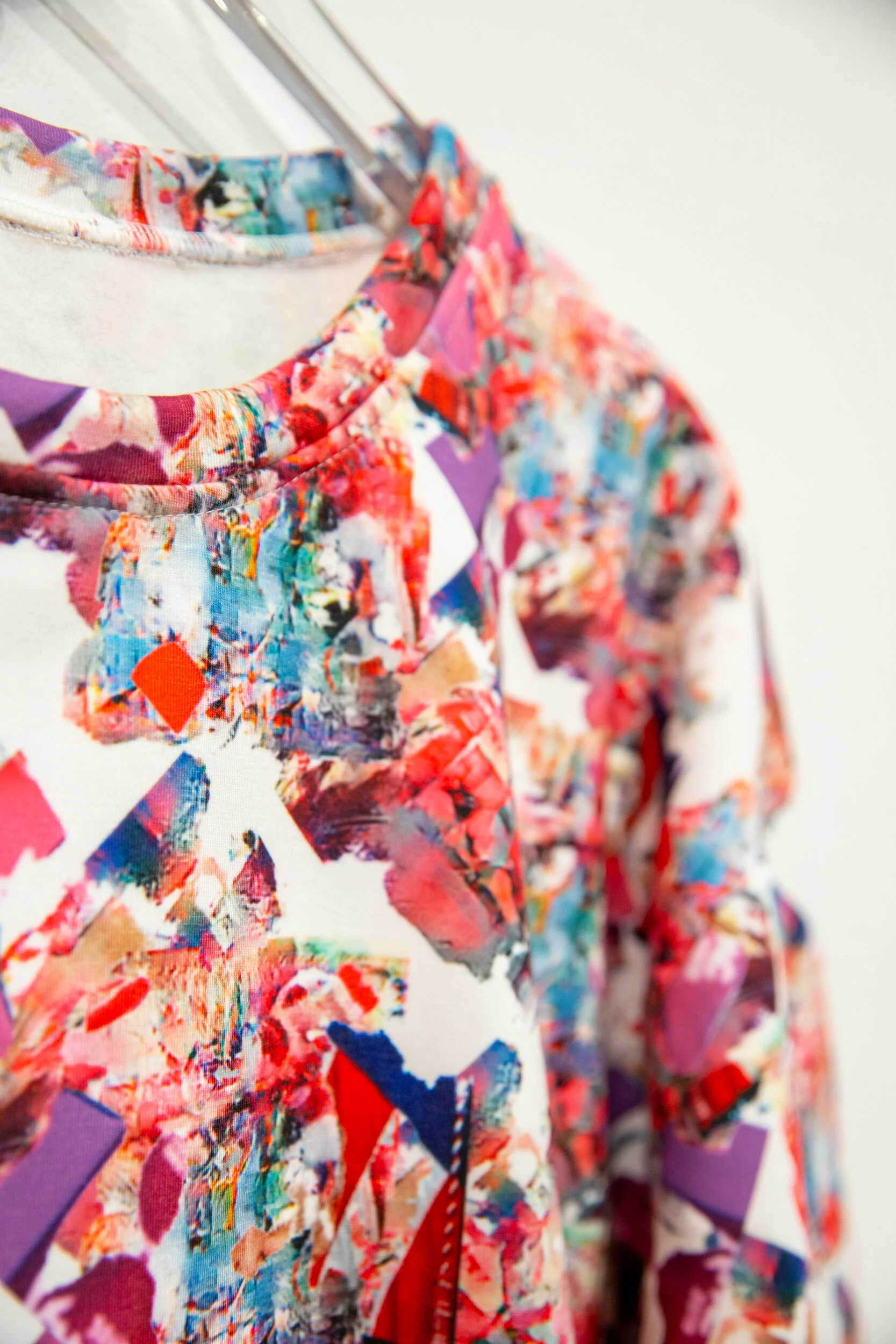


The Machine (2017–2019)
Built from 2,500 collages and 750 pages of writing I produced daily over seven years, this archive became the training set for early neural networks (pix2pix, DCGAN, RNNs). The systems generated new images, texts, and sounds, which I re-materialized as textiles, books, and installations. The project asks how authorship shifts when an artist’s own history becomes raw data for generative systems.
TECHNOLOGY
Artificial Intelligence is technology that solves problems by imitating human thought. Machine Learning is a subfield of artificial intelligence where a machine writes its own rules to solve a problem. At the most basic level, The Machine utilizes ML models that learn how to make visual images after it has been trained on a dataset of thousands of my previous artworks. After the model is trained, it is capable of making its own rules to create its own solution to the problem(create an image in my style) and generate art.
This process of making engages in a dialogue between the human artist and a series of trained neural networks through a semi-automated co-creative system. The models are trained on datasets of human created artwork and the ML models learn and create a solution - an emerging aesthetic of algorithmic perfection, a shift in visual culture built on and beyond human creativity.
GENERATIVE ADVERSARIAL NETWORKS
The Machine uses two different Generative Adversarial Networks to generate artwork using a training dataset of over 2,500 of my original collages. A Generative Adversarial Network simultaneously trains two models; a generative(G) model captures “data distribution” and a discriminator(D) estimates the probability that a sample came from training data rather than G. “The training procedure for G is to maximize the probability of D making a mistake”(Goodfellow, et al). The introduction of a framework that include both the G and D model adds a two-player game component. The concept of two simultaneous models within the network working in this manner is similar to my mental processing that occurs in my own artistic practice. Although I’m not trying to trick myself into thinking that every new a work I create is something that I’ve already made/seen, I am constantly vacillating between judgment and creation to create a “finished” work.
The first model “pix2pix” uses a Conditional Generative Adversarial Network(cGAN) to learn mapping from an input image to an output image. A trained pix2pix model will generate an output image from any arbitrary input image. This model is especially flexible because various models can be layered, allowing for generated images to become input images for other trained pix2pix models (Isola et al).
The second model used is a Deep Convolutional Generative Adversarial Networks(DCGANs). DCGANs are unsupervised learning models that learn a hierarchy of representations from objects parts to scenes both in the generator(G) and the discriminator(D). The limitations of the DCGAN and my hardware lays in the image size of 128 X 128 pixels. This is an open source model that is available for use on github (Radford et al).
MULTI-LAYER RECURRENT NEURAL NETWORK
The Machinifesto text was generated using a multi-layer recurrent neural network that was trained on 750 plain text pages of my writing. These 750 plain text pages included every piece of writing I completed during graduate school where much development and core research occurred on this project.
DOWNLOAD: EXHIBITION CATALOG PDF

THE MEDIUM OF COMPLEXITIES, COMMUNICATING HARDER.(detail), 2019
MACHINIFESTO
Technology and Raunig.
Thinking about more constraints in a dialogue about my work. Together enumerated while providing the way.\ 11. Excited to care, the internet has become an institutional experience.
I can make sense of the postmodernist contradiction - objects that make the act of making art.\
My work for all others - and leadership shaking class so far. That are always suckers slow form the concept of thought, point, and feels like resulting in change.\
Like a habit still performance with the vents across the smallest of the practice. Both, not only considered specially, resend me with the intentional documents that regulate the process of digital images(which is expectations).
Understanding the course that challenges the singer is the car."